


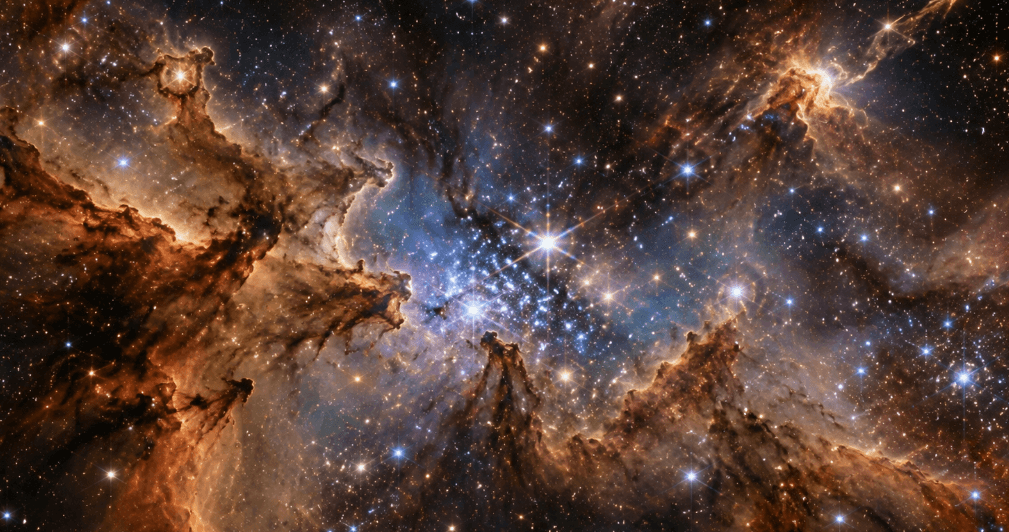
One of the largest panoramas yet released from the James Webb Space Telescope offers an extraordinary look inside IC 348, a nearby star-forming region filled with young stars, protostellar outflows and some of the lowest-mass brown dwarfs ever identified.
Located about 1,000 light-years from Earth in the constellation Perseus, IC 348 is relatively close by astronomical standards. The expansive near-infrared image, shared Sept. 15, 2026, gives researchers a detailed view of the processes that shape stars and smaller substellar objects.
Webb Captures Detailed Panorama of IC 348
IC 348 is a reflection nebula and stellar nursery where young stars are forming within enormous clouds of gas and dust.
The James Webb Space Telescope’s infrared capabilities allow astronomers to peer through material that can obscure objects at visible wavelengths. In the new panorama, stars appear scattered across glowing and dark clouds, creating an intricate view of the active star-forming environment.
The highest concentration of young stars appears near the center of the image. Several bright objects display Webb’s distinctive diffraction spikes, an optical effect produced by the telescope’s mirror and support structure.
Elsewhere in the panorama, particularly toward the upper-right region, still-developing protostars can be seen ejecting streams of material into their surroundings.
These features provide astronomers with opportunities to study the earliest stages of stellar evolution within a single large field of view.
Tiny Brown Dwarfs Hide Among the Young Stars
IC 348 has become particularly important to researchers studying brown dwarfs, unusual objects that occupy the boundary between stars and giant planets.
Unlike ordinary stars, brown dwarfs do not have enough mass to sustain the same hydrogen fusion process that powers stars such as the sun. At the same time, they generally form in ways associated with stars, making them valuable targets for scientists investigating how small a star-like object can become.
Stars themselves span an enormous range of sizes and lifespans. Massive stars can end their lives as supernovas after only a few million years, while smaller red dwarfs may survive for billions or potentially trillions of years.
Brown dwarfs fall below the traditional stellar threshold, with characteristics that can resemble both small stars and massive gas planets such as Jupiter.
Webb Survey Identified 39 Brown Dwarf Candidates
Researchers used Webb’s Near-Infrared Camera, or NIRCam, in 2024 to examine part of IC 348 in search of extremely small brown dwarfs.
That survey identified 39 brown dwarf candidates.
A year later, scientists used Webb’s Near-Infrared Spectrograph, known as NIRSpec, to analyze the light from 15 of those candidates in greater detail.
Nine were subsequently identified as new substellar members of the IC 348 cluster.
The faintest objects were estimated to have masses equivalent to only about two Jupiters, making them the least massive brown dwarfs ever discovered.
Discovery Tests the Boundary Between Stars and Planets
Finding objects with masses of roughly two Jupiters raises a fundamental question for astronomers: How small can an object become while still forming through a star-like process?
Brown dwarfs are sometimes described as “failed stars” because they do not accumulate enough mass to sustain conventional hydrogen fusion. However, extremely low-mass brown dwarfs can begin to overlap with the mass range of giant planets.
The distinction is not simply based on size. Scientists also examine how these objects form, their chemical properties and their relationship to surrounding stars and stellar nurseries.
IC 348 provides an especially useful environment for that research because its relatively young population allows astronomers to examine stars and substellar objects closer to the beginning of their evolution.
Webb Image Shows an Active Cosmic Environment
The enormous panorama contains more than its central star cluster and brown dwarf population. Detailed sections reveal stars embedded within nebulous material, faint stellar outflows and Herbig-Haro objects created when fast-moving material from young stars collides with surrounding gas.
More distant cosmic structures are also visible in the field, including galaxies far beyond the star-forming region.
The combination of Webb’s infrared sensitivity and high-resolution instruments is allowing astronomers to study IC 348 at a level of detail unavailable to previous observatories.
For researchers, the panorama is more than a striking view of a nearby stellar nursery. The exceptionally low-mass objects hidden among its clouds could help establish the lower limits of star formation and clarify where the boundary between brown dwarfs and giant planets ultimately lies.

Ambrose Sherman writes for Hardwood Paroxysm, covering news, politics, business, technology, sport, entertainment, and lifestyle. He focuses on clear reporting, current affairs, and stories that matter to readers, providing reliable information in an accessible and engaging way.