

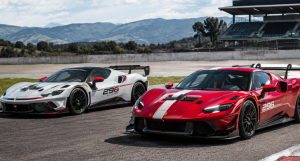



Ferrari has introduced the 296 Challenge Stradale and 296 Challenge EVO, two high-performance sports cars designed to strengthen the connection between its road-going vehicles and racing technology. Unveiled at the 2026 Ferrari Finali Mondiali in Spain, the new models emphasize lightweight engineering, advanced aerodynamics, and a more direct driving experience.
The 296 Challenge Stradale brings motorsport-inspired engineering to a street-legal sports car, while the 296 Challenge EVO builds on Ferrari’s dedicated racing platform ahead of its debut in the 2027 Ferrari Challenge season.
Ferrari Expands Its Racing Technology Into Road Cars
The two vehicles made their debut at the Circuit de Barcelona-Catalunya in Montmeló, where Ferrari hosted its annual Finali Mondiali event.
The gathering marks the conclusion of Ferrari’s racing season, bringing together Ferrari Challenge competitors, specialized racing programs, and noncompetitive track activities.
Both models demonstrate how Ferrari transfers technology between its motorsport operations and production vehicles, particularly in aerodynamics, powertrain development, and vehicle dynamics.
296 Challenge Stradale Focuses on Driver Engagement
The Ferrari 296 Challenge Stradale is designed to provide one of the closest connections to a race car within the company’s current road-car lineup.
Its stripped-down configuration prioritizes responsive handling, consistent performance, and direct communication between the driver and the vehicle.
Ferrari has emphasized predictable driving characteristics and repeatable performance, creating a road-legal sports car intended to deliver a focused driving experience.
The 296 Challenge EVO takes a different approach, refining the existing 296 Challenge racing platform with improved aerodynamic efficiency, enhanced vehicle controls, and greater consistency across varying track conditions.
Its development also brings the driving experience closer to that of the Ferrari 296 GT3 Evo.
Twin-Turbo V6 Engines Deliver Up to 700 Horsepower
Both Ferrari models use a 2,992-cc (3.0-liter), 120-degree twin-turbocharged V6 engine derived from the internal-combustion configuration found in the Ferrari 296 Speciale.
Unlike Ferrari’s hybrid-equipped 296 models, these vehicles rely exclusively on gasoline-powered engines, reducing mechanical complexity and overall weight.
Ferrari 296 Challenge Stradale Engine Specifications
The road-legal 296 Challenge Stradale produces 670 horsepower at 8,000 rpm.
Power is delivered through an eight-speed F1 dual-clutch transmission, providing rapid gear changes and responsive acceleration.
The vehicle has a dry weight of approximately 2,932 pounds (1,330 kilograms), making it about 309 pounds (140 kilograms) lighter than the Ferrari 296 GTB.
Its weight-to-power ratio stands at 1.98 kilograms per horsepower, highlighting Ferrari’s emphasis on reducing mass while maintaining high engine output.
Ferrari 296 Challenge EVO Performance Specifications
The track-focused 296 Challenge EVO increases output to 700 horsepower at 7,500 rpm.
It features a seven-speed F1 transmission and delivers a specific output of 234 horsepower per liter.
The race car shares the Stradale’s 2,932-pound dry weight, reflecting a similar focus on lightweight construction and performance.
Advanced Aerodynamics Improve Downforce and Stability
Aerodynamic development is a central feature of both new Ferrari models, with engineers focusing on increasing grip, improving stability, and maintaining consistent performance at high speeds.
296 Challenge Stradale Generates 1,360 Pounds of Downforce
The 296 Challenge Stradale produces approximately 1,360 pounds (617 kilograms) of downforce at 155 mph (250 km/h).
According to Ferrari, that represents a 72% increase compared with the 296 GTB.
Its aerodynamic package incorporates several racing-derived components, including a fixed rear wing, front splitter, aerodynamic flicks, an aero damper, vortex generators, and a fully enclosed underbody.
These elements work together to manage airflow and increase aerodynamic grip while maintaining the practical and regulatory requirements of a street-legal vehicle.
296 Challenge EVO Introduces Low-Drag Configuration
The 296 Challenge EVO delivers a 12% increase in maximum downforce compared with the outgoing 296 Challenge, equivalent to approximately 220 additional pounds (100 kilograms) at 155 mph.
Ferrari has also introduced a Low Drag configuration that reduces minimum aerodynamic drag by 4%.
The difference in aerodynamic load between the High Downforce and Low Drag configurations has more than doubled, providing greater flexibility for different racing circuits.
Additional upgrades include a wider rear-wing adjustment range, redesigned rear diffuser, updated mirrors, and lightweight carbon-fiber components.
A high-performance driveshaft with dedicated cooling improves the component’s ability to operate under demanding racing conditions.
Drivers can also increase rear ride height by up to 10 millimeters, generating approximately 66 additional pounds (30 kilograms) of downforce at 155 mph.
Race-Inspired Design Defines Both Ferrari Models
The 296 Challenge Stradale adopts a minimalist exterior design that emphasizes functional aerodynamic elements rather than decorative styling.
Ferrari has reduced unnecessary visual features to create a more purposeful appearance while maintaining a recognizable connection to the 296 Challenge EVO.
The road-going model incorporates the safety equipment, regulatory compliance, and practical considerations required for public-road use.
Meanwhile, the 296 Challenge EVO prioritizes racing performance, aerodynamic adjustability, and predictable handling under competitive conditions.
Ferrari 296 Challenge EVO Set for 2027 Racing Debut
The Ferrari 296 Challenge EVO is scheduled to enter competition during the 2027 Ferrari Challenge season, introducing improvements intended to enhance lap-time performance and consistency.
Together, the 296 Challenge Stradale and 296 Challenge EVO demonstrate Ferrari’s continued emphasis on integrating motorsport engineering into its performance-car development.
By combining powerful non-hybrid V6 engines, lightweight construction, and advanced aerodynamics, the two models reinforce Ferrari’s approach to delivering distinct but closely related driving experiences for road and track.

Ambrose Sherman writes for Hardwood Paroxysm, covering news, politics, business, technology, sport, entertainment, and lifestyle. He focuses on clear reporting, current affairs, and stories that matter to readers, providing reliable information in an accessible and engaging way.