

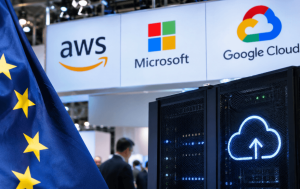


Europe’s efforts to gain greater control over critical digital infrastructure are gathering momentum as governments and regulated industries increasingly prioritize cloud sovereignty when selecting technology providers. Despite growing demand for European-controlled cloud services, major U.S. companies, including Amazon Web Services (AWS), Microsoft and Google, continue to dominate the market.
The shift reflects concerns about Europe’s dependence on American technology companies, particularly as geopolitical tensions, cybersecurity risks and service disruptions raise questions about the resilience of essential digital systems.
European Governments Prioritize Digital Sovereignty in Cloud Contracts
Digital sovereignty has been a longstanding policy objective across Europe, but recent government procurement decisions suggest those ambitions are beginning to influence actual spending.
In April, the European Commission awarded four sovereign cloud contracts valued at up to €180 million ($198 million) over six years.
The agreements involved groups led by Luxembourg’s Post Telecom and Belgium’s Proximus, alongside Germany’s StackIT and France’s Scaleway.
The Dutch government also signed a framework agreement with StackIT, describing the arrangement as a way to reduce dependence on non-European technology suppliers while strengthening digital resilience.
Other organizations, including Denmark’s state railway operator DSB, Swiss federal entities and German public broadcasters, have introduced digital sovereignty requirements into their cloud procurement processes.
These requirements are intended to reduce dependence on individual technology providers and foreign legal jurisdictions.
Public Sector and Regulated Industries Lead the Transition
Markus Noga, chief technology officer at German hosting and cloud provider IONOS, said sovereignty considerations are becoming increasingly important in purchasing decisions.
“The sovereignty criteria are something that comes much more to the forefront in the public sector and then the leading regulated industries,” Noga said.
The growing emphasis reflects concerns about maintaining uninterrupted access to essential technology services, particularly for government agencies, financial institutions and other organizations responsible for sensitive information.
U.S. Cloud Providers Adapt to Europe’s Sovereignty Requirements
Although European policymakers are seeking greater technological independence, the transition does not necessarily mean abandoning American cloud providers.
AWS, Microsoft and Google are responding to changing customer expectations by developing sovereign cloud offerings designed to address European regulatory and operational requirements.
Google Cloud’s S3NS joint venture with French defense and technology company Thales illustrates this approach.
The venture, which has received France’s SecNumCloud certification for handling sensitive government and regulated-industry workloads, was selected under the European Commission’s €180 million cloud procurement program.
Google Cloud said public-sector customers increasingly evaluate providers based on operational independence, encryption-key control and the ability to transfer applications and data between platforms.
These considerations extend beyond traditional requirements concerning where information is physically stored.
Operational Independence Becomes a Central Concern
Cloud sovereignty increasingly focuses on whether organizations can continue operating critical services without relying entirely on decisions made by foreign technology companies.
“The true value comes from not being subject to a kill switch and being able to continue your operations indefinitely,” Noga said.
Such concerns have become more prominent as European institutions assess the potential consequences of geopolitical disputes, technology restrictions and unexpected service interruptions.
However, switching cloud providers remains difficult. Existing technology investments, complex migration processes and dependence on proprietary platforms can make moving applications and data expensive and time-consuming.
These obstacles continue to favor established U.S. hyperscalers, even as European alternatives attract greater interest.
Geopolitical Tensions Accelerate Europe’s Cloud Strategy
Europe’s push for greater digital independence has intensified following U.S. President Donald Trump’s return to office.
Restrictions affecting access to certain technologies, combined with concerns about strategic dependence on American suppliers, have encouraged European governments and businesses to reconsider their technology infrastructure.
Christine Knackfuss-Nikolic, chief sovereignty officer at T-Systems, Deutsche Telekom’s IT services division, said digital sovereignty moved from a discussion topic to a practical procurement consideration during 2025.
She pointed to concerns about operational resilience, including the temporary loss of access to Microsoft services by the International Criminal Court and restrictions affecting exports of certain artificial intelligence models.
These developments have reinforced concerns about the ability of European institutions to maintain control over essential digital operations.
EU Regulations Increase Pressure on Cloud Providers
European regulatory initiatives are also encouraging organizations to reassess their relationships with cloud technology suppliers.
The European Commission’s proposed Cloud and AI Development Act aims to strengthen the region’s cloud computing and artificial intelligence infrastructure.
Meanwhile, existing regulations are increasing scrutiny of technology risks and cybersecurity practices.
DORA and NIS2 Shape Cloud Procurement Decisions
The European Union’s Digital Operational Resilience Act (DORA) establishes technology risk-management requirements for financial institutions.
The NIS2 Directive introduces broader cybersecurity obligations for organizations operating in critical sectors.
Google said these regulations are prompting customers to examine more closely who controls their information, cloud operations and essential technology systems.
As a result, cloud providers face growing pressure to demonstrate operational transparency, regulatory compliance and effective safeguards against service disruptions.
European Cloud Sovereignty Gains Momentum Despite U.S. Dominance
Europe’s cloud sovereignty movement is beginning to influence government contracts, regulatory expectations and corporate technology strategies.
However, the dominance of AWS, Microsoft and Google, combined with the complexity of migrating existing systems, means European cloud providers face significant barriers to expanding their market share.
The emerging market suggests that Europe’s immediate priority is not necessarily replacing American technology companies, but ensuring greater control, resilience and independence over the digital infrastructure supporting critical public and private services.

Ambrose Sherman writes for Hardwood Paroxysm, covering news, politics, business, technology, sport, entertainment, and lifestyle. He focuses on clear reporting, current affairs, and stories that matter to readers, providing reliable information in an accessible and engaging way.